
Copper pipe remains a common choice for water supply, heating, cooling, and other residential systems. Homeowners value it for durability, temperature tolerance, and its long history in American plumbing. Choosing the correct type and size matters because wall thickness, pressure, location, and local codes affect suitability.
Quick answer: Copper water tubing generally comes in Type K, Type L, and Type M. Type K has the thickest wall, while Type M has the thinnest. Type L is commonly selected for residential water lines. Your final choice should consider location, pressure, pipe size, and local plumbing requirements.
| Key Point | What U.S. Homeowners Should Know |
|---|---|
| Main types | Type K, Type L, and Type M |
| Common residential sizes | 1/2 inch, 3/4 inch, and 1 inch |
| Type K | Thickest wall; often used for buried or demanding applications |
| Type L | Medium wall; widely used for residential water distribution |
| Type M | Thinner wall; permitted for certain indoor uses in some jurisdictions |
| Common forms | Rigid straight lengths and flexible coils |
| Joining methods | Solder, brazing, compression, press, or push fittings |
| Main selection factors | Application, pressure, size, location, cost, and local code |
Key Takeaways
- Type K has the thickest wall among the three common water-tube grades.
- Type L offers a useful balance between strength and material cost.
- Type M has a thinner wall and isn’t suitable for every application.
- Residential systems commonly use 1/2-inch and 3/4-inch nominal sizes.
- Tube size affects available water flow and pressure performance.
- Local plumbing rules should guide the final material selection.
- Proper installation matters as much as choosing the correct tubing.
What Makes Copper Plumbing Different?
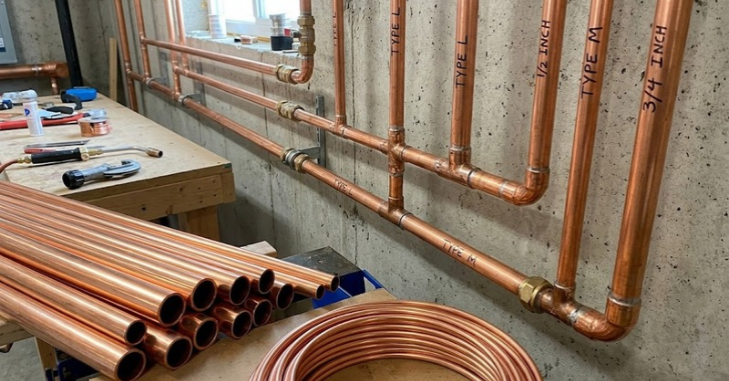
This Copper Pipe plumbing material combines rigidity, heat tolerance, and long service potential when conditions are suitable. Unlike flexible PEX, rigid metal tubing usually requires planned turns and fittings around obstacles. Flexible coils are also available where gentle bends make installation easier.
Standard water tubing follows established dimensions, making compatible fittings widely available. ASTM B88 covers drawn water tube used for general plumbing applications. The Copper Development Association also documents plumbing, heating, refrigeration, and related applications for the material.
If you are dealing with an active leak rather than planning new work, speed matters. My URL Pro’s guide to emergency plumbing problems explains when household pipe failures may require professional attention. Read the emergency plumbing guide
Copper Pipe Types: K, L, and M Explained
The letters K, L, and M identify different wall thicknesses rather than different nominal outside sizes. Type K has the heaviest wall, Type L sits in the middle, and Type M is thinner. Their appropriate applications can differ because installation conditions and local rules affect material requirements.
Type K
Type K uses the thickest wall among these three common water-tube categories. It is frequently associated with underground service lines and applications needing greater wall thickness. Its additional material also makes it more expensive than thinner alternatives.
That extra thickness does not mean every house should use Type K everywhere. Indoor residential plumbing often does not require its heavier construction. A qualified plumber can determine whether the added thickness benefits the planned installation.
Type L
Type L has a medium wall thickness and is commonly used in residential water systems. It can support hot and cold potable-water applications when installed under appropriate conditions. Blue markings commonly identify hard Type L tubing.
This grade often provides a practical balance between durability and material use. Its suitability still depends on the planned location, pressure, and applicable plumbing rules. Check local requirements before purchasing materials for permanent installation.
Type M
Type M uses a thinner wall than Type L and Type K. It may be used for certain indoor residential applications where local rules permit it. Red markings commonly identify this grade on hard tubing.
Its lower material content can make it less costly than heavier grades. That benefit does not make it appropriate for buried service or every pressurized system. Local code and project conditions should determine whether it belongs in your installation.
DWV and ACR copper
Two more types round out the family. DWV (drain, waste and vent) copper has the thinnest walls of all and is only rated for gravity drainage, not pressurized water, so it is mostly found in older homes before plastic drain lines took over. ACR tubing is made for air conditioning and refrigeration lines; it is cleaned, capped and sized by its actual outside diameter rather than the nominal size used for water pipe.
What the color markings mean
Manufacturers print a colored stripe or lettering along each length so you can identify it on the job:
- Green: Type K, the heaviest wall, for underground service lines.
- Blue: Type L, the all-round choice for interior supply lines and hydronic heating.
- Red: Type M, the thinnest pressure-rated wall, common in residential supply lines where codes allow it.
- Yellow: DWV, for drain and vent lines only.
Common Sizes and What They Mean
Residential water systems often use nominal sizes such as 1/2 inch, 3/4 inch, and 1 inch. Smaller branches frequently serve individual fixtures, while larger lines can support greater combined demand. Correct sizing also depends on run length, fixture demand, and system design.
The nominal measurement should not be treated as an exact outside-diameter measurement. Standard water tube has an outside diameter one-eighth inch larger than its nominal size. Wall thickness then changes the available inside diameter between grades.
| Nominal Size | Common Residential Role | Important Consideration |
|---|---|---|
| 1/2 inch | Fixture branches | Flow demand and run length |
| 3/4 inch | Larger branches or supply runs | Combined fixture demand |
| 1 inch | Higher-demand supply sections | System layout and pressure |
| Larger sizes | Specialized or commercial work | Engineering and code requirements |
Pipe sizing should not rely on a simple room-by-room guess. An undersized line can affect performance when several fixtures operate together. A plumber can account for fixture units, distance, pressure, and local sizing rules.
Rigid Versus Flexible Tubing
Rigid tubing comes in straight lengths and works well for planned, accessible runs. Installers usually use fittings when they need sharp changes in direction. Accurate measuring and cutting become especially important with this form.
Flexible or annealed tubing comes in coils and can form gradual bends. That flexibility can reduce the number of fittings needed around certain obstacles. It must still be bent correctly because excessive force can flatten or kink the tube.
Planning other household systems can reveal similar maintenance considerations. My URL Pro’s HVAC problem guide covers warning signs homeowners can identify before repairs become more serious. See the HVAC warning-sign guide
How Copper Compares With PEX
PEX is flexible and can often complete long runs with fewer directional fittings. Metal tubing is rigid in its drawn form and commonly needs more precise measuring and additional connections. These installation differences can influence both labor and project complexity.
The materials also respond differently to jobsite conditions. PEX is easier to route through many tight spaces, while metal tubing offers established joining methods and strong heat resistance. Neither material is automatically correct for every property or project.
| Factor | Traditional Metal Tubing | PEX |
|---|---|---|
| Form | Rigid or flexible coil | Flexible |
| Direction changes | Often requires fittings | Can bend around obstacles |
| Common connections | Solder, press, compression, push | Crimp, clamp, expansion, push |
| Installation speed | Often slower | Often faster |
| UV exposure | Material tolerates sunlight better | Prolonged exposure can be a concern |
| Code choice | Depends on application | Depends on application |
For homeowners, the useful question is not which material wins universally. The better choice depends on code, budget, existing plumbing, labor access, and project goals. A repair may also favor compatibility with the system already inside the house.
Common Joining Methods
Soldered joints remain one established method for connecting fittings and water tubing. Other available methods include brazed, compression, press, and push-to-connect fittings. The correct connection depends on the application and the fitting manufacturer’s requirements.
Soldering involves heat, surface preparation, flux, and suitable solder. Press systems use specialized equipment to mechanically form a sealed connection. Push fittings can simplify selected repairs, especially where working space is limited.
Repairs around fixtures can involve problems beyond supply tubing. My URL Pro’s article on fixing a leaky faucet shows how plumbers diagnose common faucet leaks. Read how plumbers approach leaky faucets
Advantages Worth Considering
One major advantage is the material’s established use across residential plumbing systems. It tolerates hot and cold water and comes in standardized sizes and grades. It can also be recycled after removal from service.
Its rigid form can create neat, predictable installations in open framing or accessible utility spaces. Compatible fittings are widely available across several connection methods. Properly designed systems can remain dependable for decades under suitable operating conditions.
Limitations and Problems to Watch
Cost is one practical disadvantage because metal piping generally requires a larger material investment than some alternatives. Rigid installations may also require more fittings and labor around structural obstacles. Those factors can increase the installed price of a large repiping project.
Freezing conditions remain a concern despite the material’s strength. Water expanding inside a frozen line can damage plumbing, so cold-weather protection still matters. Water chemistry, excessive velocity, installation quality, and corrosion conditions can also affect service life.
Routine attention elsewhere in the home can reduce surprise repair costs too. My URL Pro has a broader guide covering household appliance maintenance and problems caused by neglected equipment. Explore the home-maintenance guide
Two more issues are worth knowing about. In areas with aggressive water chemistry, copper can develop small pinhole leaks over time, often first seen as green staining or damp spots at joints. And if you are working on an older house, check for lead-based solder: it was banned for drinking water plumbing in the US in 1986, so any new joints must use lead-free solder and flux.
How to Choose the Right Option for Your Project
Start by identifying exactly where the line will run and what it must carry. An underground service line has different demands from an indoor fixture branch. Hot-water, cold-water, HVAC, and refrigeration applications can also follow different specifications.
Next, confirm the required nominal diameter and acceptable wall grade. Do not choose a size because it looks similar to an existing line. Flow demand, run length, available pressure, and local requirements should support that decision.
Then consider how the new section will connect with existing materials. Connections between dissimilar metals may require appropriate transition methods to limit corrosion problems. This is especially important when older galvanized components remain in the system.
Finally, check the plumbing code enforced in your local U.S. jurisdiction. Rules may determine which grades and joining methods are permitted for specific uses. Professional advice becomes worthwhile when the job affects main supply lines or concealed plumbing.
Make the Choice Based on the System, Not the Label
Copper pipe can be an effective option when its grade, size, and installation method match the job. Type K, L, and M serve different needs, while nominal diameter affects system flow and performance. Local plumbing requirements should remain part of every final decision.
Before purchasing materials, identify the application and verify the required tube size. Check local code before opening walls or changing a main water line. For uncertain repairs, ask a licensed plumber to assess the existing system and recommend a compatible solution.
Frequently Asked Questions
How long does copper pipe last?
There is no single guaranteed lifespan because operating conditions differ between homes. Water chemistry, workmanship, temperature, pressure, and corrosion can change how long a system remains dependable. Some industry guidance places well-maintained installations in multi-decade service ranges.
Is Type L or Type M better for a house?
Type L has a thicker wall and is widely used for residential water distribution. Type M uses less material and may be accepted for selected indoor applications. Local code and installation conditions should decide between them.
What size is most common in residential plumbing?
Half-inch and three-quarter-inch sizes appear frequently in residential water systems. Larger supply sections may use one-inch tubing when system demand requires it. Proper sizing depends on fixture demand, pressure, and distance.
Can homeowners install it themselves?
Some experienced homeowners can complete limited plumbing repairs, depending on local rules. Cutting, joining, sizing, fire safety, and leak testing require proper tools and technique. Permits or licensed work may also be required in some jurisdictions.
Can it connect to other plumbing materials?
Yes, suitable transition fittings can connect different approved piping materials. The exact method depends on the materials, application, and local requirements. Dissimilar-metal connections deserve special attention because improper contact can encourage corrosion.
What do the colors on copper pipe mean?
The printed color identifies the wall thickness: green is Type K, blue is Type L, red is Type M and yellow is DWV drain pipe. Thicker walls handle higher pressure and last longer underground.