

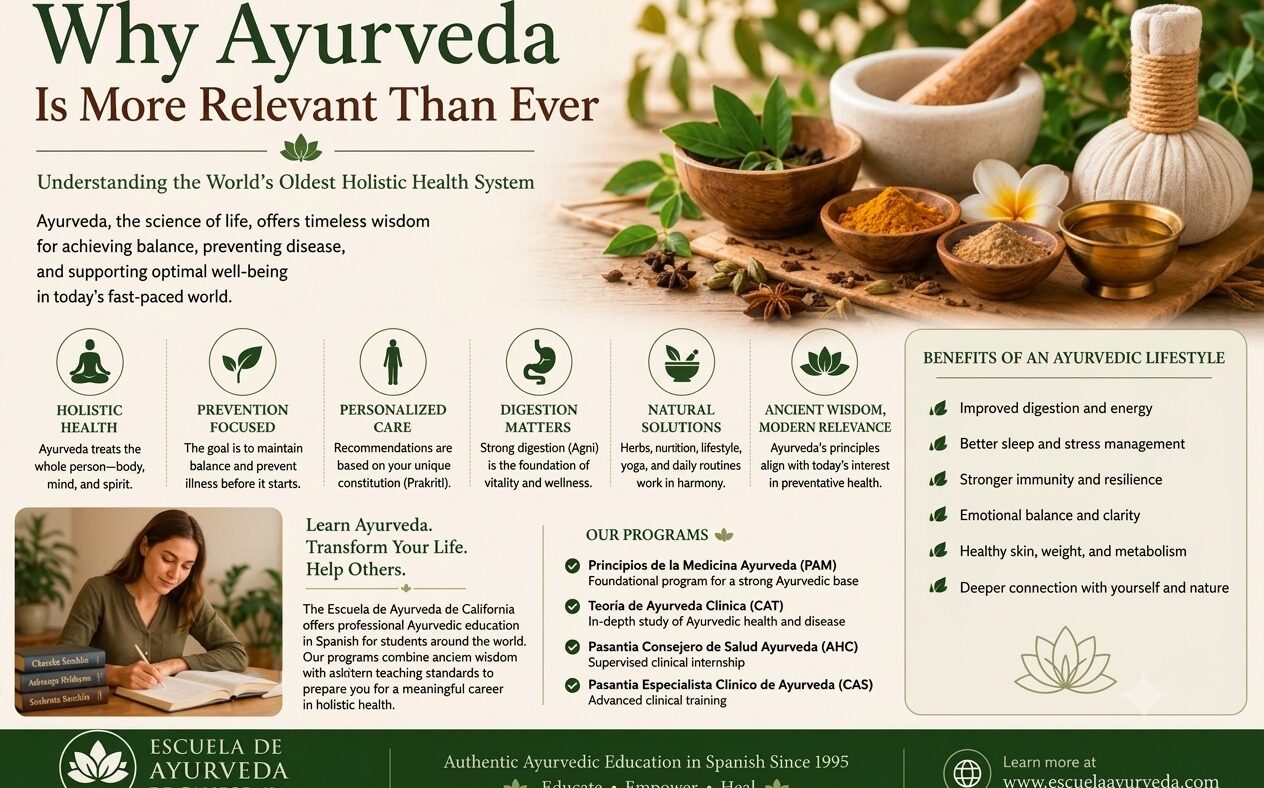
In an era where chronic stress, poor sleep, digestive disorders, and lifestyle-related diseases continue to rise, more people are searching for approaches that emphasize prevention rather than simply treating symptoms. One of the oldest and most comprehensive systems of natural health is Ayurveda, a tradition that has guided healthy living for more than 5,000 years.
Although Ayurveda originated in India, its principles are now studied and practiced worldwide. Healthcare professionals, wellness coaches, yoga teachers, nutritionists, and individuals seeking a more balanced lifestyle are increasingly exploring this ancient science.
What Is Ayurveda?
The word Ayurveda comes from the Sanskrit words Ayus, meaning “life,” and Veda, meaning “knowledge” or “science.” Together, Ayurveda is often translated as “The Science of Life.”
Unlike healthcare systems that focus primarily on diagnosing and treating disease, Ayurveda emphasizes maintaining health before illness develops. It views wellness as the balance of body, mind, emotions, and environment.
Rather than offering identical recommendations to everyone, Ayurveda recognizes that every individual has unique physical and mental characteristics that require personalized guidance. This individualized approach is one of the reasons Ayurveda continues to attract attention in modern integrative health discussions.
The Principle of Individuality
A cornerstone of Ayurvedic philosophy is the belief that no two people are exactly alike. According to Ayurveda, each person has a unique constitutional blueprint known as Prakriti, which is determined by the balance of three biological principles called Doshas:
- Vata governs movement, communication, and the nervous system.
- Pitta regulates digestion, metabolism, and transformation.
- Kapha provides structure, stability, and nourishment.
Every individual possesses all three Doshas, but in different proportions. Understanding this unique constitution allows Ayurvedic practitioners to recommend personalized nutrition, daily routines, and lifestyle practices.
Today, this concept resonates with the growing interest in personalized medicine and individualized nutrition.
Digestion Is Central to Health
Ayurveda considers digestion to be one of the most important determinants of health.
The concept of Agni, often translated as “digestive fire,” represents the body’s ability to digest food, absorb nutrients, and transform them into healthy tissues.
When digestion functions efficiently, the body receives proper nourishment. When digestion becomes impaired, Ayurveda suggests that imbalance may develop over time.
For this reason, Ayurvedic nutrition focuses not only on what people eat but also on when they eat, how they prepare meals, and whether those foods are appropriate for their constitution.
Ayurveda Is More Than Herbal Medicine
Many people associate Ayurveda exclusively with herbs such as Ashwagandha, Triphala, Turmeric, or Brahmi. While herbal medicine is an important component, it represents only one part of a much larger healthcare system.
Traditional Ayurveda includes:
- Personalized nutrition
- Daily routines (Dinacharya)
- Seasonal living (Ritucharya)
- Yoga
- Meditation
- Breathing exercises (Pranayama)
- Ayurvedic massage (Abhyanga)
- Sleep optimization
- Stress management
- Preventive healthcare
This holistic perspective explains why Ayurveda continues to gain popularity among people interested in sustainable wellness rather than quick solutions.
Scientific Interest Continues to Grow
Modern scientific research has increasingly explored various aspects of Ayurveda. Universities and research institutions around the world are investigating traditional herbs, nutrition, gut health, inflammation, stress physiology, and lifestyle interventions inspired by Ayurvedic principles.
Certain herbs, including Ashwagandha and Turmeric, have received significant scientific attention for their bioactive compounds.
Although researchers emphasize that more high-quality clinical studies are needed to fully understand many traditional applications, there is growing recognition that preventive lifestyle practices deserve greater attention within modern healthcare.
Importantly, reputable Ayurvedic educators encourage evidence-informed practice and emphasize that Ayurveda should complement—not replace—appropriate medical care.
Prevention Rather Than Reaction
One of Ayurveda’s greatest strengths is its preventive philosophy. Instead of waiting for disease to appear, Ayurveda encourages individuals to develop habits that support long-term health, including:
- Eating freshly prepared foods
- Maintaining regular daily routines
- Sleeping adequately
- Managing stress effectively
- Exercising appropriately
- Spending time in nature
- Cultivating emotional balance
These recommendations align closely with many contemporary public health initiatives promoting healthier lifestyles.
Why Education Matters
As Ayurveda becomes increasingly popular online, misinformation has also become more common.
Simplified social media posts often reduce Ayurveda to body-type quizzes, detox products, or herbal supplements without explaining the underlying philosophy.
Authentic Ayurvedic education requires studying classical principles, anatomy, physiology, pathology, nutrition, ethics, and clinical reasoning.
Understanding concepts such as Doshas, Prakriti, Agni, Ama, Dhatus, and Srotas provides a much deeper appreciation of Ayurveda than isolated wellness trends can offer.
Choosing education from an established institution helps students distinguish traditional knowledge from unsupported health claims.
Learning Ayurveda Through Structured Education
Interest in professional Ayurvedic education has expanded significantly over the past decade.
Students today come from diverse backgrounds, including healthcare professionals, massage therapists, yoga instructors, nutritionists, psychologists, and individuals simply seeking a deeper understanding of holistic health.
One institution dedicated to making authentic Ayurvedic education accessible to Spanish-speaking communities is the Escuela de Ayurveda de California.
As the Spanish-language division of the California College of Ayurveda, the school offers structured educational programs based on classical Ayurvedic teachings while integrating modern educational standards.
Students from Latin America, Spain, the United States, and other countries participate in online programs that explore Ayurvedic philosophy, nutrition, constitutional assessment, lifestyle medicine, and traditional therapies.
The school’s mission is not only to teach Ayurvedic concepts but also to preserve the integrity of one of the world’s oldest systems of natural health.
The Future of Ayurveda
As healthcare increasingly shifts toward prevention, personalized wellness, and integrative approaches, Ayurveda continues to offer valuable perspectives that complement modern scientific understanding.
Its emphasis on nutrition, daily habits, emotional well-being, sleep, and individualized care reflects concerns shared by many healthcare professionals today.
While Ayurveda is not intended to replace conventional medicine, its holistic philosophy encourages people to take an active role in maintaining their health through sustainable lifestyle choices.
For individuals interested in learning this ancient science from experienced educators, the Escuela Ayurveda de California provides comprehensive educational programs designed specifically for Spanish-speaking students around the world. Escuela is a proud member of the Ayurveda Alliance.
Whether your goal is personal growth, professional development, or a deeper understanding of holistic health, studying Ayurveda offers an opportunity to explore one of humanity’s oldest and most enduring traditions of wellness.
Apart from that, if you want to know about How Can Pre-Pregnancy Planning Help Prevent Complications then please visit our Health Category.