


Most stores do not need every channel at once. They need the two or three that pay at their current size, run by people who can show that revenue has moved. This guide covers what an ecommerce digital marketing agency should own at each stage of growth. It also covers 2026 pricing and how to tell a working retainer from a stalled one.
Short answer: a full-funnel partner runs paid acquisition, organic search, email and SMS, creative, and on-site conversion work as one plan. Expect $2,500 to $5,000 a month for one or two channels. A real multi-channel scope runs $5,000 to $15,000, and more than $15,000 once you pass eight figures.
The short version, by store size
Fee ranges mean nothing without the work behind them. Here is what stores at each size usually buy, and what agencies quote for it.
| Store Revenue | Ecommerce Digital Marketing Agency Channels That Earn Their Keep | Typical Scope | Typical Monthly Fee |
| Under $1 million | One paid channel, plus core email flows | One channel managed, flows built once | $2,500 to $5,000 |
| $1 million to $5 million | Meta, Google Search and Shopping, email and SMS | Two to three channels, monthly creative batch | $5,000 to $10,000 |
| $5 million to $20 million | The above, plus organic search, marketplaces, on-site testing | Four channels, a creative pod, weekly reporting | $10,000 to $20,000 |
| $20 million and up | The above, plus loyalty, subscriptions, holdout testing | Full pod, strategy lead, measurement analyst | $20,000 to $50,000 |
Key takeaways
- Buy channels in the order your revenue can support them. A $600,000 store running five channels is spreading one budget five ways.
- A multi-channel scope is priced by channel count, creative volume, reporting depth, and who does the work.
- An in-house team of four costs $350,000 to $550,000 a year once tools and hiring are counted.
- The hybrid model, one owner inside plus outside execution, suits most stores between $5 million and $20 million.
- Judge the partner on MER, blended customer acquisition cost, and contribution after marketing. Not on screenshots of platform dashboards.
What an Ecommerce Digital Marketing Agency Full-Funnel Scope Actually Contains

Full funnel is a phrase agencies use loosely. In practice, an ecommerce digital marketing agency owns the entire customer journey from the ad that earns the click and the page that converts the visitor to the message that brings them back weeks later. The work splits into five key buckets, and a scope that quietly skips one of them is not truly full funnel, regardless of what the pitch deck says.
- Paid acquisition. Meta, Google Search and Shopping, TikTok, plus Amazon if you sell there. Judged on new-customer cost, not on platform-reported return.
- Organic search. Category and product page structure, technical fixes, and content that answers buying questions. It is slower than paid and cheaper per order once it lands. If nobody can explain your category page structure, this bucket is decoration. Ask how their expert SEO services for an online store handle faceted pages before you sign.
- Retention. Email and SMS flows, list segmentation, and a sending calendar someone keeps. At maturity, this should carry 25% to 35% of store revenue.
- Creative. Eight to twenty new ad concepts a month at scale. Creative volume, not bid tinkering, is what moves paid performance now.
- On-site conversion. Page speed, product page layout, search and filtering, checkout tests. Everything upstream gets cheaper when this improves.
Ask which of the five the agency does in-house and which they subcontract. Both answers can be fine. Not knowing is not.
Which channels earn their place at each stage
Below $1 million, buy one paid channel and your email flows. That is the whole plan. Pick the platform your product demands and put the rest of the budget into photography. A welcome flow, an abandoned cart flow, and a post-purchase flow then do the quiet work. Those three alone often carry a fifth of revenue, which is why email marketing that increases sales beats a second ad platform at this size.
Between $1 million and $5 million, add the second paid channel and real creative volume. Ad spend commonly runs 20% to 30% of revenue here, and most of the gains come from testing offers and hooks rather than from bidding. This is also the stage where SMS starts to pay for itself.
From $5 million to $20 million, organic search and marketplaces stop being optional. Paid gets more expensive as you push past the easy audiences, so the cheaper orders have to come from somewhere. Retention becomes a program with a calendar, a segmentation model, and a loyalty offer, rather than four flows built two years ago.
Past $20 million, targeting stops being the lever. Measurement and offers take over. Mature brands typically hold 40% to 50% of the budget in paid and 25% to 30% in retention. Another 5% to 10% goes to channels that might not work at all. That last slice is the one growth stalls without.
How a multi-channel scope gets priced
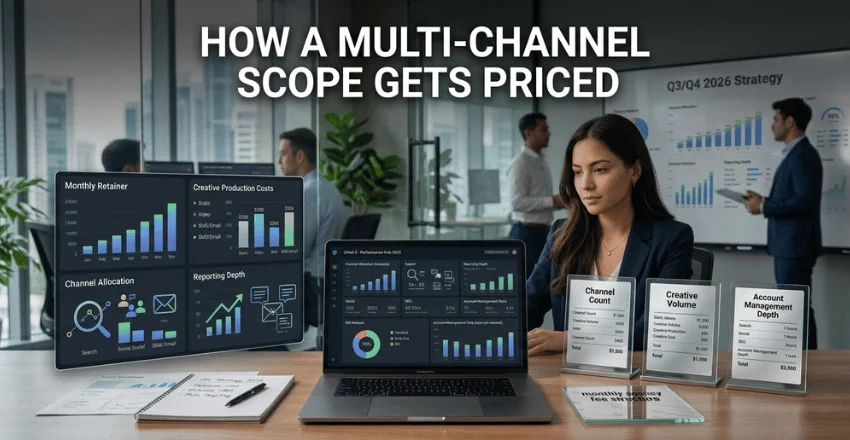
Two agencies can quote $8,000 for scopes that share almost nothing. Ask what drives their number before you compare it against anyone else’s.
- Channel count. Each added platform brings its own build, its own reporting, and its own weekly attention. Three channels is not one channel times three, but it is not free either.
- Creative volume. Twenty concepts a month costs more than four. Ask how many are net new versus recut.
- Reporting depth. A dashboard link is cheap. A monthly read on contribution after marketing, with a named analyst behind it, is not.
- Who touches the account. A senior strategist for six hours a month prices differently from a coordinator for forty.
Percentage-of-spend pricing is the odd one out here, because it pays the agency more for spending more of your money. A flat monthly fee against a written deliverable list is easier to hold to account, and easier to compare between two quotes.
In-house, agency, or hybrid
The build-versus-buy argument usually gets framed as a cost question. It is a question about breadth. One hire gives you deep attention on one or two channels. A retainer gives you shallow attention across five.
Here is the honest comparison, using loaded costs rather than base pay.
| Year-one cost | $350,000 to $550,000 for four people, plus $30,000 to $50,000 in tools | $60,000 to $180,000 for a mid-sized scope | $150,000 to $250,000 for one manager plus a lean retainer |
| Time to start | Three to five months of hiring | Two to four weeks | Six to eight weeks |
| Channel breadth | Narrow, whoever you hire | Broad by design | Broad, with one owner inside the building |
| Main risk | Average tenure runs 18 to 24 months, and knowledge walks out with the person | Attention split across other clients | Coordination overhead between the two sides |
| Best for | $20 million and up with steady demand | $1 million to $20 million, or any store rebuilding a channel | $5 million to $20 million scaling quickly |
- In-house wins on product knowledge, response speed, and long-term cost per channel once you spend above roughly $500,000 a year on media.
- In-house loses on breadth, on holidays and sick weeks, and on the eight-week gap after somebody resigns.
- An agency wins on speed, on cross-account pattern recognition, and on being replaceable without a redundancy process.
- An agency loses when your account is small enough to be handed to whoever is free that week.
Our recommendation for most stores between $1 million and $20 million is the hybrid. Hire one in-house owner who controls strategy and budget, then buy execution and creative from outside. You keep the knowledge, and you keep the option to change suppliers without losing a quarter.
Below $1 million, a lean retainer alone is enough. Above $20 million, start moving paid media in-house and keep the agency for the channels you run occasionally.
The reporting pack that proves it worked
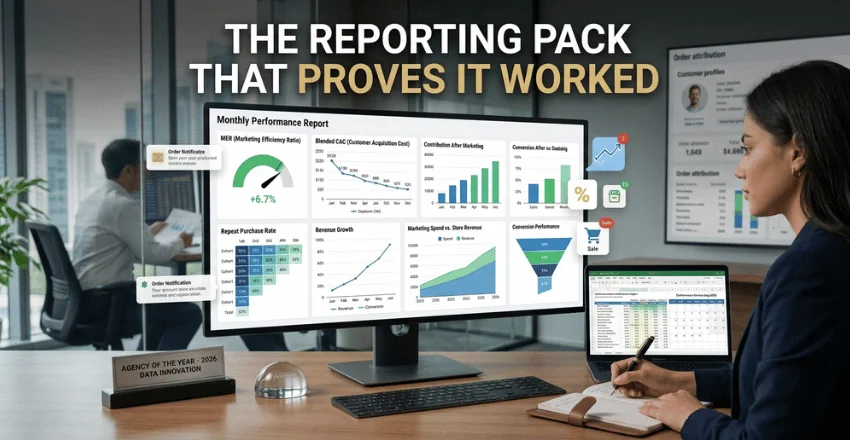
Platform dashboards will always claim more revenue than your bank statement shows. Every channel counts the same order, so three dashboards report the same sale three times. That gap is why a good agency reports at the whole-business level, and why a weak one keeps showing you screenshots.
Four numbers belong in the monthly pack. MER, which is total store revenue divided by total marketing spend. Blended customer acquisition cost, which is total spend divided by new customers. Contribution after marketing, which is gross profit minus that spend. Repeat purchase rate by monthly cohort, which tells you whether the new customers were worth buying.
Work an example. A $4 million store spends $79,000 a month at a 4.2 MER, so revenue lands near $333,000; at a 60% product margin, that is $200,000 of gross profit, leaving $121,000 after media and about $112,000 after a $9,000 fee. Change the MER to 3.4, and that surplus falls by roughly $40,000 a month. The fee was never the number that mattered.
Once a year, ask for a geo holdout: switch off a channel in a set of matched regions for four weeks and compare. It is the only cheap way to see what your ads genuinely added.
Your first 90 days, and what to check before renewal
Good onboarding looks the same almost everywhere, and vague onboarding is the earliest warning you will get.
- Days 1 to 30. Access granted, tracking audited and fixed, baseline MER and margin agreed in writing, quick wins shipped.
- Days 31 to 60. First creative batch live, email flows rebuilt, one structured test running with a stated hypothesis.
- Days 61 to 90. Scaling decisions made on evidence, a written read on what worked, and a plan for the next quarter.
By day 90 you should have a baseline number, a test log, and one channel measurably better. If all three are missing, do not renew, whatever the deck promises for month four. That check matters more than any pitch, though it helps to read a short primer on choosing the right marketing company before you shortlist anyone. Rolling 90-day terms with 30 days’ notice are now common, so a twelve-month lock-in with no exit deserves a hard question.
Where to go from here
Start with your revenue and your product margin. Add the two channels you already run. Then ask three shortlisted partners for a 90-day plan priced against that reality, and pick the one whose plan you could argue with. Vague plans are easy to agree to and impossible to hold to account.
Frequently asked questions
Between $2,500 and $50,000, depending on how many channels are in scope. Stores doing $1 million to $10 million usually land between $5,000 and $15,000 a month. Anything under $2,500 buys reporting and little else.
Whichever one matches how people find your product, plus email flows underneath it. Demand-capture products start on Google. Discovery products start on Meta or TikTok.
It happens, but it is no longer the default. A 90-day initial term followed by a rolling arrangement is fairer to both sides, since real signal takes about a quarter to appear.
You should. Insist that every ad account and sending platform sits under your ownership from day one, with the agency added as a user. Ask for creative files and flow exports at handover too.
Paid and email move within four to eight weeks. Organic search takes four to six months. Anyone promising fast rankings is selling something else.