

Omni Man vs Homelander sounds like a perfect battle between two terrifying Superman-style characters. Both can fly, move at extreme speeds, and overpower most opponents in their respective worlds. Yet their similar power sets hide a major difference in strength, durability, and combat experience.
The short answer: Omni-Man would likely defeat Homelander in a direct fight. Homelander has dangerous heat vision and enhanced senses, but Nolan has more combat experience and proven durability. The biggest difference is that Nolan regularly fights powerful opponents, while Homelander rarely faces anyone near his physical level.
| Category | Omni-Man | Homelander |
|---|---|---|
| Universe | Invincible | The Boys |
| Origin | Viltrumite | Compound V-enhanced human |
| Super strength | Yes | Yes |
| Flight | Yes | Yes |
| Enhanced speed | Yes | Yes |
| Heat vision | No | Yes |
| Enhanced senses | Yes | Yes |
| Combat experience | Extensive | Limited by comparison |
| Main advantage | Strength, durability, experience | Heat vision, ranged attacks |
| Likely winner | Omni-Man | Major underdog |
Why Omni Man vs Homelander Is Such a Popular Matchup
The comparison works because both characters twist the traditional image of an all-powerful superhero. They can appear heroic to the public while hiding darker motives and violent behavior. Their stories explore what happens when extraordinary power exists without ordinary accountability.
Their television success also puts them in front of overlapping American audiences. Invincible presents Nolan Grayson as Mark Grayson’s powerful father. The Boys makes its caped antagonist a public celebrity whose identity depends heavily on power and image.
The similarities make the matchup easy to imagine, but they don’t make the fighters equal. Their fictional universes establish different ceilings for superhuman strength and punishment. That difference becomes important once the battle moves beyond their shared abilities.
Readers interested in the actor behind the live-action character can also read MyURLPro’s profile of Antony Starr’s movies and television career. MyURLPro also maintains an Entertainment section covering film, television, and popular culture. These pages provide more entertainment coverage beyond fictional matchups.
Comparing Their Powers and Abilities
Both fighters possess the basic abilities needed for a spectacular aerial battle. They have superhuman strength, exceptional durability, enhanced speed, and independent flight. Neither needs conventional weapons to cause enormous physical damage.
The key distinction is how those abilities operate within each character’s story. Nolan is Viltrumite, a race built for violent confrontations with powerful enemies. Skybound describes his son Mark’s abilities as coming from his Viltrumite heritage.
Homelander’s abilities come from Compound V rather than alien biology. His powers include flight, strength, durability, heat vision, and enhanced senses. His broader selection gives him more ways to attack from a distance.
Strength
Raw strength is probably the most important category in this fight. Nolan has repeatedly demonstrated the physical power needed to battle beings capable of seriously hurting him. His fights are often extended contests, not effortless attacks against ordinary humans.
His opponent is tremendously strong within The Boys, but his world generally operates at a lower physical scale. Dominance in one fictional universe doesn’t automatically translate to dominance in another. Cross-universe comparisons work better when feats and opposition are considered together.
This distinction favors the Viltrumite once both characters start trading blows. He is accustomed to opponents who can survive powerful strikes and respond with comparable force. That experience makes his strength more useful during a prolonged fight.
Speed and Flight
Flight gives both characters exceptional mobility and removes the limitations of a ground-based fight. Each can rapidly change direction and attack from positions ordinary people can’t reach. Speed can also turn their physical bodies into dangerous weapons.
Nolan has repeatedly used flight aggressively, not merely for transportation. He can combine momentum with physical attacks and pursue other superpowered opponents through the air. His fighting style makes aerial movement part of his offense.
Homelander can also fight while airborne and attack from range. His heat vision means he doesn’t always need to close the distance. That ability gives him a key tactical option in the opening stages.
Durability
Durability may create the largest practical problem for Homelander. Winning requires more than hurting an opponent once. He needs to inflict enough damage to stop someone accustomed to brutal Viltrumite battles.
Nolan has survived severe injuries and continued fighting in the Invincible universe. His species can withstand punishment that would immediately kill ordinary humans. Viltrumites aren’t indestructible, but defeating one generally requires extraordinary force.
Homelander is also resistant to conventional attacks and far tougher than a normal person. Yet his durability exists within a world where powerful Supes can injure other Supes. That raises an important question: how long could he survive repeated Viltrumite-level attacks?
Does Heat Vision Give Homelander a Chance?
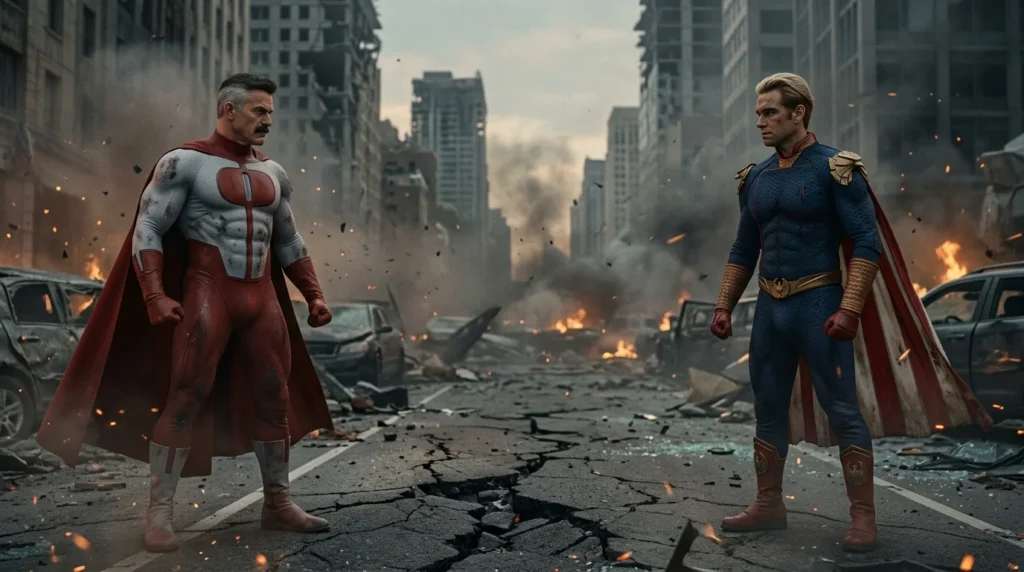
Heat vision is the clearest ability that separates the two combatants. It gives Homelander a ranged weapon his opponent cannot directly duplicate. He could attack before Nolan closes to close-combat range.
That advantage matters, but possessing a unique weapon doesn’t guarantee enough stopping power. The beam must cause meaningful damage before the distance closes. A ranged advantage disappears quickly when the target can fly toward the attacker at extreme speed.
Heat vision therefore creates a tactical opportunity rather than a reliable victory condition. It could force Nolan to react and might cause damage under favorable circumstances. It doesn’t erase the larger differences in close-range combat and experience.
Combat Experience Changes the Fight
Power comparisons often focus on abilities while overlooking the person using them. That mistake matters here because these characters have dramatically different fighting histories. One comes from a warrior civilization, while the other usually dominates weaker opponents.
Nolan has extensive experience with conquest, lethal combat, and powerful enemies. He understands how to continue fighting after taking serious damage. He also knows how to exploit openings against opponents who can physically challenge him.
Homelander often relies on intimidation and overwhelming natural advantages. Those tactics work when almost nobody can match his physical power. They become less reliable against an opponent who isn’t intimidated and can survive the opening attack.
Experience also affects decision-making once the original plan fails. A veteran fighter can adapt when an opponent survives an expected finishing move. That adaptability becomes especially valuable in a battle between superpowered opponents.
What About Their Weaknesses?
Neither character is completely invulnerable. Viltrumites can suffer serious injuries, especially against opponents with comparable physical abilities. Certain frequencies can also disrupt their equilibrium, but exploiting that weakness requires specific circumstances.
Homelander has enhanced senses that could help him spot opportunities in a fight. His varied powers allow more experimentation than simple hand-to-hand combat. He could use distance and heat vision instead of trading punches.
The problem is converting an opening into a decisive finish. A weakness matters only when an opponent can identify, reach, and exploit it effectively. More abilities don’t automatically provide enough damage to defeat a tougher combatant.
How the Fight Would Probably Play Out
The opening moments would likely favor Homelander’s preferred options. He could stay airborne, create distance, and use heat vision before committing to physical combat. That approach gives him his best opportunity to control the encounter.
Nolan would have strong reasons to close that distance quickly. Once the fight becomes physical, his experience against durable enemies becomes increasingly important. He can absorb punishment while applying sustained pressure instead of depending on one decisive attack.
A longer battle therefore works against Homelander. His ranged options become harder to exploit when his opponent controls the distance. Repeated close-range exchanges would increasingly favor the fighter accustomed to brutal contests with superpowered enemies.
Comics Versus TV Versions
The answer can change slightly depending on which versions you’re comparing. Comic adaptations don’t always preserve every feat or power level exactly. Television versions may also present abilities differently for storytelling purposes.
For a fair comparison, readers should establish the versions before debating individual feats. Mixing a comic feat from one character with television-only evidence for the other creates an uneven comparison. Using comparable versions produces a clearer argument.
Even with that limitation, the central difference remains similar across common interpretations. Nolan is generally portrayed as a seasoned Viltrumite combatant who routinely enters dangerous physical battles. His opponent’s greatest strengths remain versatility, ranged attacks, and extraordinary power within his own setting.
Has This Battle Ever Happened?
The matchup has become famous outside either character’s main story. A 2022 Death Battle episode specifically matched the two characters and declared Nolan the winner. That result isn’t canon to either original fictional universe.
The characters have also appeared in Mortal Kombat 1, bringing both franchises into the same video game. Game balance shouldn’t be treated as evidence of their canonical power levels. Fighting games deliberately make different characters competitive so gameplay remains enjoyable.
These appearances still show why the matchup continues attracting attention. Both characters occupy similar places in modern superhero culture despite coming from different stories. Their visual similarities make the underlying power differences more interesting to compare.
Omni-Man vs Homelander: Who Would Win?
Omni-Man vs Homelander most strongly favors Omni-Man because he combines superior combat experience with greater demonstrated physical endurance. Homelander’s heat vision gives him a useful ranged advantage. It probably isn’t enough to overcome the larger differences once the battle becomes a sustained physical confrontation.
That doesn’t mean the fight must end instantly in every imagined scenario. Cross-universe battles have no official universal rules, and writers can alter circumstances. Preparation, environment, surprise, and chosen versions can all affect how long the confrontation lasts.
Under standard conditions, though, Nolan has the clearer route to victory. He can survive long enough to close the distance and force physical exchanges. Once that happens, Homelander loses the advantage his broader power set provides.
Frequently Asked Questions
Who is stronger: Omni-Man vs. Homelander?
Omni-Man is generally portrayed with greater physical strength and experience against powerful opponents. Homelander remains exceptionally strong within The Boys, but strength must be compared alongside durability and opposition. Those categories collectively favor the Viltrumite.
Can Homelander’s laser vision hurt Omni-Man?
Heat vision could hurt him, depending on the crossover rules. No canonical fight establishes exactly how the beam interacts with Viltrumite durability. It is safer to treat heat vision as a threat rather than an automatic finishing attack.
Is Homelander faster than Omni-Man?
Both characters can move and fly at superhuman speeds. Direct numerical comparisons are difficult because comics and television scenes don’t always use consistent measurements. Nolan’s combat movement and intercontinental flight feats make speed another difficult category to compare.
Are Omni-Man and Homelander based on Superman?
Both clearly use traits associated with the powerful flying superhero archetype. Their stories then take those familiar traits in darker directions. Each character uses enormous power to explore themes that traditional heroic stories often approach differently.
Could Homelander win with preparation?
Preparation could improve his chances by helping him investigate Viltrumite vulnerabilities. Yet knowing a weakness and exploiting it against an experienced opponent are separate challenges. Nolan’s speed and combat history would still make executing such a plan difficult.
Who has more combat experience?
Nolan has substantially more meaningful combat experience in his fictional history. He comes from a culture built around conquest and has fought opponents who could seriously injure him. Homelander spends much more time dominating weaker adversaries.
Final Takeaway
This matchup looks balanced because the characters share flight, strength, speed, and extreme durability. A closer comparison shows that similar abilities don’t necessarily mean similar power levels. Combat history and the kinds of enemies each character survives provide essential context.
Nolan’s strongest advantages are his physical resilience and experience in lethal battles. Homelander’s biggest advantages are heat vision, enhanced senses, and a wider range of attacks. Those advantages make the fight interesting, but not necessarily even.
Readers who enjoy superhero television, character profiles, and pop-culture comparisons can explore more stories in MyURLPro’s Entertainment coverage. The site’s Antony Starr profile also covers the actor whose performance helped make Homelander a recognizable modern television character.