

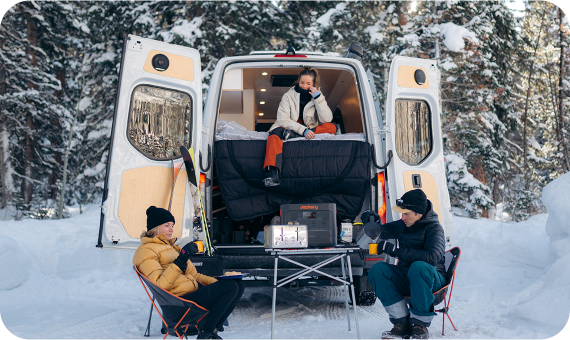
The most effective way to cut generator noise on a caravan trip is to replace a fuel-burning generator with a solar-charged portable power station, which has no engine and runs close to silent. If you must use a fuel generator, choose an inverter model, place it as far from campsites as the cord allows with the exhaust pointing away, and run it only during permitted hours. Aim for equipment rated below about 50 dB so you stay comfortable at night and within most campground rules.
Below you will find where caravan noise actually comes from, how noise limits typically work at campgrounds and parks, a step-by-step method for sizing a quiet power source, and a close look at two popular quiet generators for caravans. Whether you are planning a weekend away or a long lap of the country, these steps will help you keep the power on and the peace intact.
Where Noise Comes From on a Caravan Trip
Not every sound can be controlled, but knowing the sources helps you focus on the ones you can.
Engine and Mechanical Noise
While you are driving, the tow vehicle or motorhome engine produces a steady hum, and vibration travels through the chassis and fittings. Loose cupboard contents, rattling cutlery and poorly secured gas bottles add to it. Packing soft items between hard ones and checking fittings before each leg makes a noticeable difference.
Wind and Road Noise
At highway speeds, wind rushing around the van and tire noise on coarse surfaces create a constant background roar. Correct tire pressures, well-sealed windows and hatches, and avoiding unnecessary roof-mounted gear all reduce it. These sounds stop when you park, though, so they matter less than what happens at camp.
Generators and Other Power Sources
At the campsite, the generator is usually the loudest thing around. Conventional open-frame petrol generators are notorious for loud, uneven engine noise, and even quieter inverter generators produce a constant drone that carries in still evening air. That is why many campgrounds and national parks restrict generator use to set hours, require designated generator areas, or ban fuel generators entirely.

Understanding Noise Limits at Campgrounds
There is no single national noise limit for caravan parks. Rules are set by state or local authorities, park agencies and individual park operators, and they vary from site to site. What most have in common is:
- Quiet hours: Most parks enforce quiet hours from evening until morning, when generators must be switched off or kept very low.
- Generator restrictions: Many national parks and bush campgrounds either ban generators or allow them only in specific zones and time windows.
- Complaint-based enforcement: Even where there is no decibel figure, a noisy setup that disturbs neighbors can lead to warnings or being asked to leave.
For context, decibels (dB) are logarithmic, so every 10 dB increase sounds roughly twice as loud. The table below shows typical everyday sound levels to help you compare equipment ratings.
| Approximate level | Comparable sound | What it means at camp |
|---|---|---|
| About 30 dB | Whisper, quiet library | Barely noticeable, even at night |
| About 40–50 dB | Quiet room, soft conversation | Comfortable for most neighbors |
| About 60 dB | Normal conversation | Noticeable at nearby sites, especially at night |
| About 70 dB and above | Busy street, vacuum cleaner | Likely to draw complaints and breach park rules |
Always check the rules of the park or campground you are booking. Park websites and booking pages usually spell out generator policies and quiet hours.
Why a Quiet Solar Generator Suits Caravan Travel
A “solar generator” is a portable power station: a large lithium battery with a built-in inverter and outlets, recharged from solar panels, mains power or your vehicle. For caravan travelers it solves several problems at once.
Near-Silent Operation
Fuel generators make noise because they burn fuel in an engine with moving parts. A power station has no engine at all. The only sound is typically a cooling fan that runs under heavy load, which is why good models are rated somewhere between library-quiet and soft conversation.
Respecting Neighbors and Park Rules
Because they are so quiet, power stations can usually run through quiet hours without bothering anyone, and many parks that ban fuel generators allow battery systems. That saves you from awkward conversations, warnings, or having to pack up early.
Less Disturbance for Wildlife
Many animals rely on hearing to find food and avoid danger. Constant engine noise can drive wildlife away from waterholes and feeding areas, which is the opposite of what most nature-loving travelers want. A silent power source lets you enjoy birdsong and nocturnal wildlife instead of drowning it out.
No Fumes, No Fuel Storage
Fuel generators produce carbon monoxide and must be run well away from the van, awnings and open windows. Power stations produce no exhaust, so there is no fume risk, and you do not have to carry jerry cans of fuel in the tow vehicle.
A Better Camp Experience
Stargazing, a quiet conversation by the fire or an early-morning coffee all feel different without a motor droning in the background. That is ultimately the reason many people choose caravan travel in the first place.
Quiet Power Options Compared
| Option | Typical noise | Pros | Cons |
|---|---|---|---|
| Open-frame fuel generator | Loud | Cheap, high output | Noisy, fumes, often banned in parks |
| Inverter fuel generator | Moderate | Cleaner power, quieter than open-frame | Still audible, fumes, fuel to carry |
| Portable power station with solar | Very quiet (fan only) | Silent, no fumes, easy to use | Limited by battery capacity and sunshine |
| Fixed lithium house battery with roof solar | Silent | Integrated, always ready | Higher installation cost |

How to Choose a Quiet Generator for Your Caravan Trip
Use these steps to narrow down the right unit for your setup.
- Check the noise rating. Look for a published dB figure and how it was measured (distance and load). For a peaceful trip, target equipment rated below about 50 dB, and compare that with the rules of the parks you plan to visit.
- List your appliances and their wattage. Note the running watts of everything you want to power: fridge, lights, fans, laptop, coffee maker, CPAP machine and so on.
- Estimate daily energy use in watt-hours (Wh). Multiply each device’s watts by the hours you will run it per day, then add them up.
- Check peak output. The power station’s continuous output must exceed the biggest appliance you will run at once. Kettles, microwaves and induction cooktops draw a lot.
- Add a buffer. Choose a capacity around 20–30% above your daily total to allow for cloudy days and inverter losses.
- Plan recharging. Work out how you will top up: solar panels, mains power at powered sites, or charging from the vehicle while driving.
- Consider weight and space. A larger battery is heavier. Make sure you can lift it and secure it safely in the van.
Worked Example: Sizing for a Weekend Away
| Device | Watts | Hours per day | Energy (Wh) |
|---|---|---|---|
| 12V/compressor fridge (average draw) | 50 | 24 | 1,200 |
| LED lights | 20 | 5 | 100 |
| Phone and laptop charging | 60 | 3 | 180 |
| Fan | 30 | 6 | 180 |
| Coffee maker | 1,000 | 0.2 | 200 |
| Total | 1,860 Wh |
In this example, a station of around 2,000 Wh plus solar recharging would comfortably cover a day, while a 1,000 Wh unit would need daily topping up or a lighter load. Check your own appliances’ labels, as real figures vary widely.
Look for Noise-Reducing Features
Beyond the headline dB figure, useful features include a quiet or silent charging mode, smart fan control that only spins up under heavy load, LiFePO4 (lithium iron phosphate) batteries for long cycle life, and the option to add expansion portable battery packs as your needs grow.
Two Quiet Jackery Generators for Caravans
Jackery is a well-known maker of portable power stations, and two of its solar generators are popular with caravan travelers. The figures below are the manufacturer’s published specifications; check current specs before buying, as models are updated.
Jackery Solar Generator 2000 Plus
The 2000 Plus has a 2042.8Wh capacity that can be expanded to around 12kWh with add-on battery packs, which makes it suitable for longer off-grid stays. Jackery rates it at about 30 dB in quiet operation, roughly library level. Its 3000W output can run high-draw appliances such as a kettle, microwave, induction cooker or portable air conditioner. It recharges from AC in about 1.7 hours, or in roughly 6 hours with six 100W SolarSaga panels in good sun. The LiFePO4 battery is rated for 4,000+ cycles to 70% capacity. The trade-off is weight, at about 27.9 kg (61.5 lb).
Jackery Solar Generator 1000 Pro
The 1000 Pro is a lighter option with a 1002Wh capacity and 1000W output, suited to shorter trips and moderate loads like a fridge, lights, fans, laptops and small kitchen appliances used briefly. It is rated at around 46 dB, comparable to a quiet conversation. It recharges from AC in about 1.8 hours, or around 9 hours with two 80W SolarSaga panels. At about 11.5 kg (25.4 lb), it is much easier to carry.
Side-by-Side Specifications
| Feature | Solar Generator 2000 Plus | Solar Generator 1000 Pro |
|---|---|---|
| Battery capacity | 2042.8Wh (expandable to 12kWh) | 1002Wh |
| Max output | 3000W (6000W surge peak) | 1000W (2000W surge peak) |
| Noise level | About 30 dB | About 46 dB |
| AC charging time | About 1.7 hours | About 1.8 hours |
| Solar charging time | About 6 hours (6 × 100W panels) | About 9 hours (2 × 80W panels) |
| Weight | 27.9 kg (61.5 lb) | 11.5 kg (25.4 lb) |
| AC outlets | 3 × 230V | 2 × 230V |
| USB-C | 2 × 100W | 2 × 100W |
| USB-A | 2 × 18W max | 2 × 18W max |
| Car port | 12V/10A | 12V/10A |
| Cycle life | 4,000+ cycles to 70%+ | 1,000+ cycles to 80%+ |
| Panel water resistance | IP65 | IP65 |
| Operating temperature | -10°C to 65°C (14°F to 149°F) | -10°C to 65°C (14°F to 149°F) |
Choose the 2000 Plus if you want to run high-draw appliances or stay off-grid for several days. Choose the 1000 Pro if you mainly need to keep a fridge, lights and devices running on shorter trips and want something easy to lift.
Common Mistakes When Buying a Quiet Generator
- Buying on capacity alone. A big battery with too little continuous output still cannot run a kettle or microwave.
- Ignoring how noise was measured. A dB figure at idle or from several meters away is not the same as one under full load at one meter.
- Underestimating solar. Panel ratings assume ideal sun; shade, heat and winter angles can cut real output by a third or more.
- Forgetting the fridge. It runs around the clock and is usually the largest daily load, so size for it first.
More Ways to Keep Your Camp Quiet
- Place equipment thoughtfully. Even a quiet unit is best kept on a soft mat, off hollow floors that amplify fan noise.
- Charge while driving. Top up from the vehicle or DC-DC charger during travel days so you rarely need to run anything loud at camp.
- Run high-draw appliances by day. Use kettles and microwaves while the sun is charging the battery.
- If you still carry a fuel generator, use an inverter model, point the exhaust away from neighbors, keep it well clear of the van for carbon monoxide safety, and switch off before quiet hours.
- Reduce demand. LED lighting, efficient fans and a well-insulated fridge all shrink the battery you need.
Quiet power is about more than comfort. It keeps you on good terms with neighbors and rangers, and it makes camping outdoor trips feel like a real escape.
FAQs
What is the quietest type of generator for a caravan?
A portable power station charged by solar panels is the quietest option, since it has no engine and usually only makes fan noise under heavy load. Inverter fuel generators are quieter than open-frame models but are still clearly audible.
How many decibels should a quiet caravan generator be?
Aim for under about 50 dB for comfortable use around camp, especially in the evening. Units rated around 30 to 46 dB are close to library or soft-conversation levels.
Can I run a generator in a national park?
It depends on the park. Many national parks ban generators or restrict them to set areas and hours, so check the park’s rules before you go. Battery power stations are generally more widely accepted because they are silent and fume-free.
What size solar generator do I need for a caravan trip?
Add up the watt-hours your appliances use each day and choose a unit about 20 to 30 percent larger. A fridge, lights and device charging typically need roughly 1,000 to 2,000 Wh per day, depending on the fridge and weather.
Can a solar generator run a caravan air conditioner?
A high-capacity unit with enough continuous output can run a small air conditioner, but it will drain the battery quickly. Check your air conditioner’s starting and running watts against the station’s output and plan for expansion batteries or mains power.
How do I reduce noise from an existing fuel generator?
Use it only during permitted hours, place it as far from campsites as safely possible with the exhaust facing away, and set it on a soft surface to reduce vibration. Never enclose it in a box without ventilation, as this creates a fire and carbon monoxide hazard.
Bottom Line for a Quieter Caravan Trip
Most noise at camp comes from the power source, so that is where the biggest gains are. Work out your daily watt-hours, choose a solar power station with enough capacity and a low dB rating, recharge during the day, and check each park’s rules before you arrive. Do that, and your caravan trips will sound like the bush, the beach or the stars instead of an engine.
Looking for more reading? Check out Basketball Shoes in Australia: Enhancing Performance and Style with AND1 or browse our Lifestyle category.